• feedland.com or feedland.org?

    I was asked about the difference between feedland.com and feedland.org. Which should you create a new account on?

    feedland.org runs on a small Digital Ocean server, and feedland.com runs in a data center. The first is a fixed-size relatively small scale server that can’t expand, and the latter is designed to scale automatically according to demand. I spent most of 2023 converting the software to run in the scalable environment.

    If you’re creating something new, definitely create it on feedland.com. If you’re already using feedland.org, for now you’re welcome to continue, but in the back of your mind think about creating a new account on Com and importing your subscription list. Org is proving useful to have around, so I don’t imagine it’ll go away, it’s much easier for me to work on a DO server than on the big cloud-based server.

    You should assume that some day all these systems will disappear. The web is ephemeral. But — my guess is feedland.com will be around longer. However, honestly, I really have no idea, no one does.

  • Filtering items in news product timelines

    I’ve got the News Product runtime open and am working on it today, probably tomorrow too.

    Added a feature that lets you write a very simple one-like JavaScript expression to decide if an element is displayed in a news product timeline. You can see it in the JSON spec for the site. Here’s the expression:

    feedItem.enclosure !== undefined

    The filter has a feedItem object available to it, containing all the info about the item that’s being considered. You can see what’s available in by clicking on the icon under the item in the river. It’s the same object in both places.

    In that filter, I’m checking if the item has an enclosure. You could also test if a string appears in the title:

    feedItem.title.includes ('Peeksill') ||  feedItem.title.includes ('Kingston')

    I’m not sure how useful this will be, but it was very easy to add, and we already had a standardized set of values associated with every item, so why not give it a try?

    One tab, why display?

    If a news product has only one tab, we only show the content. This was illustrated in the test version of podcatch.com.

  • Removing duplicates from feed lists

    Reading lists are a relatively new feature, and we’re still cleaning up bits like this one.

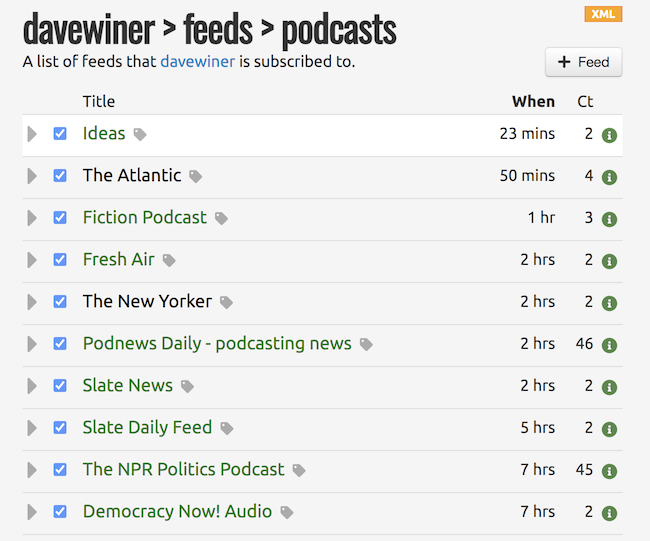
    Suppose I have subscribed to a feed, then subscribe to a reading list that includes that feed. Then I will see the feed twice in the list. One in green, indicating its from a feeding list, and one in black, for feeds I have directly subscribed to.

    Here’s a screen shot that illustrates. The Atlantic and New Yorker both appear twice.

    This morning I changed the way it works.

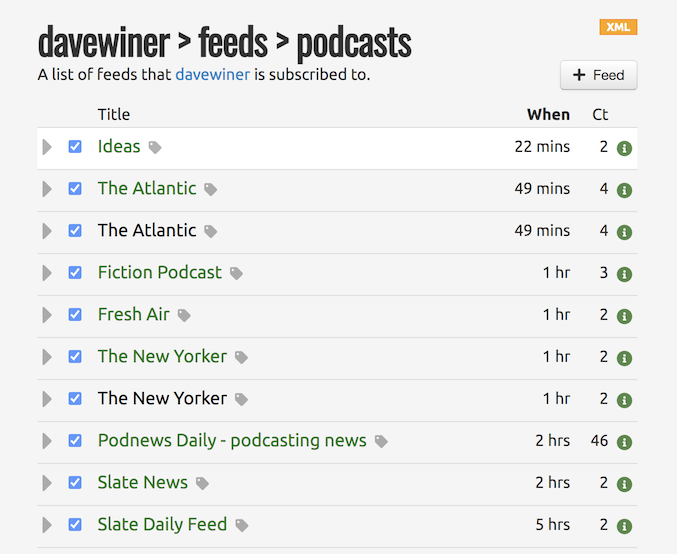
    • A feed appears no more than once in a list.
    • We favor the original subscription.

    Here’s a screen shot of the same feed list with the duplicates removed.

  • Updating a feedCorps reading list

    I have a bunch of feedCorps reading lists, started in October.

    At the time, I developed a distribution system for them, and a process for updating reading lists.

    I just added some subscriptions to my podcasts reading list, and am about to re-discover and document the process for updating a list.

    1. The goal is to get your updated OPML file into the lists directory in the new support repo. In order to do that you will need to be a contributor to the site, or submit a pull request that one of the contributors can approve.
    2. Any file there is available through lists.feedcorps.org. For example here’s the podcasts list, accessed through that site.
    3. You can use any tool to manage your reading list, but of course we recommend using FeedLand. Pick a category for this list, for podcasts the category is podcasts. When you want to add a feed, subscribe to it in the normal way and add the category in the settings dialog, and choose it from the dialog with category checkboxes.
  • New framework for news products

    I’m working on the next rev of the API for news products, and along with it a new more flexible runtime.

    For now, here’s a screen shot of the new news.scripting.com, which is the prototype site I’m working with.

  • The power of open formats

    Andrew Hickey is one of my favorite bloggers, and it’s somewhat weird because..

    • He blogs on Bluesky but it works because..
    • John Spurlock added RSS 2.0 feeds for Bluesky, built on their API, I am able to subscribe Hickey’s observations in FeedLand, because..
    • Of course FeedLand understands RSS.

    And it all happened without getting complicated. No federation needed. Just plain old RSS.

    https://feedland.com/?river=https://rss.firesky.tv/?filter=from:andrewhickey.bsky.social

    Of course FeedLand is not the only service that understands RSS 2.0. That’s why it’s such a silo buster and user empowerer.

    I am lobbying everyone I know to add great feed support to social media systems, so we can get out of the mode of dominant platforms before Threads becomes the dominant platform.

    PS: Yes, I’ve heard Threads plans to peer with Mastodon and other ActivityPub-compatible services, but I’m from Missouri, and I’ve given FB a lot of chances, and they always blow off open formats when they can, so why would one think this time would be different?

  • A sub-domain for your feed?

    I was starting to think how I wanted to use my outbound feed  on feedland.com and then I had the usual not happy feeling that it’s indelibly bound to data.feedland.com, and if I ever want to move it, it’ll be a pain in the butt.

    This is what it looks like.

    https://data.feedland.com/feeds/davewiner.xml

    But then I realized this is a place where DNS comes in handy.

    So could we sell people a subdomain of feedland.blog..

    https://dave.feedland.blog/rss.xml

    I’ve always thought that selling subdomains for little things was a useful idea. There was a time when I wanted to have a subdomain for a document.

    Maybe this is a good place to start, try it out.

    Also feed-only blogs are a hot thing these days. Just wrote about it this morning, but didn’t make the connection till just now. And FeedLand’s feeds are exactly what people are talking about.

    Also I want to get back in the habit of writing here. 🙂

  • Timelines, Blogrolls and OPML lists

    Using Scripting News as a model, three ways to view my blogroll of bloggers —

    • a timeline
    • a list of HTML links you can click on with a few comments about why you find them interesting (traditional view of a blogroll)
    • an OPML subscription list that can be subscribed to

    right now on my blog home page we only offer one — the river

    i’ve been trying to imagine how to expand that to cover the other three views

    i don’t expect to find a solution in the tabs on mobile, i think scripting news is going to need a menubar soon

    it had one before, but they fall out of date, i don’t tend to maintain them, people don’t look in the menus (hamburger lists are like menus)

    we hope that doesn’t happen with the river because it’s self-updating, there’s always a reason to look there

  • rssCloud report

    Yesterday we got updates from our own sources to show up on feedland.com in real time. There was an incompatibility in the way our rssCloud service provider sent pings to the new server.

    This is a milestone for me, because finally my own feeds, such as my linkblog and Scripting News, appear on feedland.com instantly, as fast as they appear on Mastodon or Bluesky. Also the personal feeds managed by feedland.com or feedland.org.

    Today, with any luck the new version of Scripting News will go live, with a FeedLand timeline baked in.

  • Toward WordPress integration

    A new project this morning, feedlandRiverInclude.

    The minimum you need to be able to include a timeline from FeedLand in a browser-based app.

    Just a few lines of JavaScript and a bunch of includes.